Total Pageviews

Showing posts with label Starters. Show all posts

Wednesday, January 22, 2014

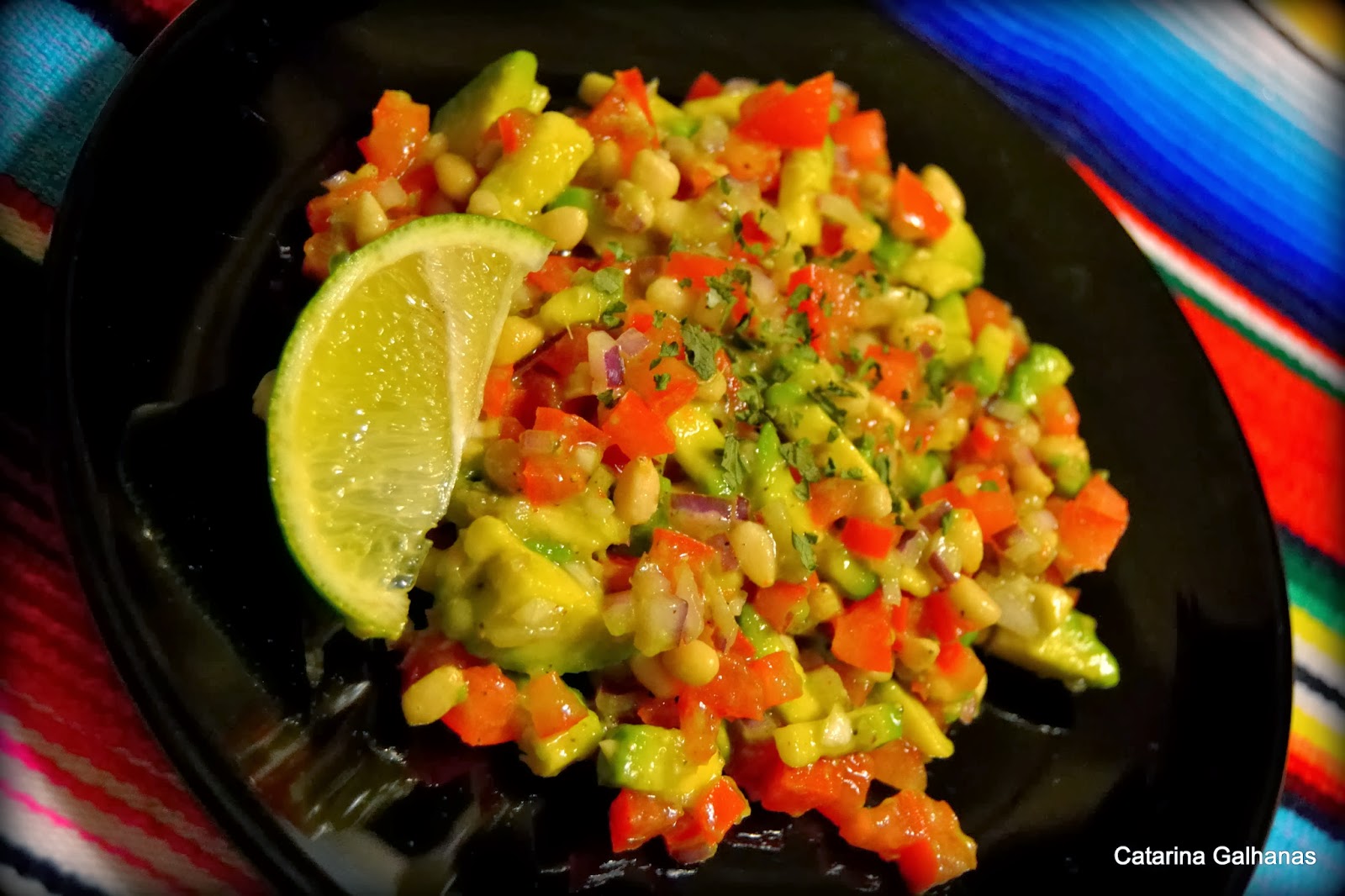
AVOCADO SALAD


The avocado (Persea gratissima or P. americana) gets its name from the Latin American Nahuatl word ahuacatl meaning "testicle," an obvious reference to the shape of the fruit. It was discovered in Mexico approximately 291 B.C. The more easily-pronouced name of avocado is attributed to Sir Henry Sloane, who coined it in 1669. The word itself first appeared in American print in 1697. Early Spanish explorers discovered the Aztecs enjoying avocados, but it was long considered a tasteless food. The Aztecs also used avocados as a sexual stimulant. It was the Spanish explorers who brought the avocado to the English.


Serves 2
20 minutes
258 kcal per serving


Ingredients
  • 30 g of pine nuts
  • 200 g tomatoes, without seeds
  • 40g red onion, finely chopped
  • 120 g avocado, diced into small pieces
  • 2 limes
  • A small handful of coriander leaves
  • Sea salt and freshly ground black pepper

Method
  1. Roast the pine nuts in a dry pan.
  2. Mix the pine nuts with the tomatoes, red onion and avocado in a bowl.
  3. Drizzle the lime juice over the salad.
  4. Season with salt, pepper and coriander leaves.

Monday, July 22, 2013

BRIE STUFFED BEEF TOMATO


A beefsteak tomato (American English) or beef tomato (British English) is any of the largest varieties of cultivated tomatoes, some weighing 450 g or more. This meaty tomato is grown in a rainbow of colors, from vibrant red to pale yellow to purple-black. Rather than maintaining a perfectly spherical shape as it develops, it takes on a decided kidney-bean shape, spreading out to the sides. While popular among home growers for sandwich making and other applications requiring a large tomato to be eaten raw, beefsteaks are not grown commercially as often as other types, since they are not considered as suitable for mechanization as smaller slicing tomatoes. It is one of the slowest-maturing tomatoes, with the largest beefsteak cultivars taking up to 90 days to produce ripe fruit. Typically, the vine will continue to produce and set fruit until the first frost.


Serves 4
45 minutes
342 kcal per serving


Ingredients
  • 4 beef tomatoes
  • 2 tbsp French herbs
  • 1 tbsp olive oil
  • 2 tbsp balsamic vinegar
  • 200 g Brie cheese, sliced
  • 4 tbsp pesto
  • 1 red onion, peeled and sliced

Method
  1. Preheat the oven to 175 °C.
  2. Cut the top of the tomatoes and scoop out and discard their seeds.
  3. Place them on a baking sheet with parchment paper.
  4. Sprinkle with the French herbs and salt, then drizzle with olive oil and balsamic vinegar.
  5. Bake in the oven for 15-20 minutes.
  6. Distribute the brie cheese and pesto in the tomatoes, then top with the onion and bake for another 10 minutes or until the cheese has melted.

Wednesday, April 17, 2013

POTATO KEFTEDES


In traditional Greek cuisine Keftedes are made from ground meat, typically either lamb of beef. It’s combined with a couple finely diced vegetables, spiced, rolled into balls, and either seared or roasted as a shish kabob. This recipe takes the concept, along with many of the flavoring components, and applies it to potatoes rather than meat.

Serves 4
40 minutes
235 kcal per serving


Ingredients
  • 750 g potatoes, peeled and sliced
  • 1 bunch scallions, finely chopped
  • 1 red chilli, seeded and finely chopped
  • 1 tbsp olive oil
  • 1 egg
  • Salt and black pepper

Method
  1. Boil the potatoes in lightly salted water until cooked through, between 10 and 15 minutes.
  2. Pour off the cooking water and mash the potatoes.
  3. Sauté the spring onions and chillies in 1 tsp of olive oil in a skillet on low heat.
  4. Mix it with the mashed potatoes.
  5. Add the egg, then season with salt and pepper.
  6. Shape the potato mixture into 8 patties.
  7. Fry them in the rest of the olive oil in a skillet over medium heat until they are nicely browned, 2-3 minutes per side.
  8. Serve with e.g. tzatziki.

Wednesday, February 27, 2013

FRESH THAI STYLE SPRING ROLLS


Spring rolls are a large variety of filled, rolled appetizers. The name is a literal translation of the Chinese chūn juǎn found in East and Southeast Asian cuisine. The kind of wrapper, fillings, and cooking technique used, as well as the name, vary considerably within this large area.The Spring Roll has a long history of over a thousand years. It was called Spring Cakes in the Sung Dynasty. This dynasty reigned in northern China from 992AD to 1126AD.


Serves 8
15 minutes
55 kcal per serving


Ingredients
  • 8 spring roll rice paper wrappers
  • 50 g fresh bean sprouts
  • 2 spring onions, sliced
  • 1/2 red pepper, seeded and thinly sliced
  • 2-3 leaves Chinese cabbage, finely shredded
  • 50 g peeled cooked shrimp
  • 1 tsp rice vinegar or white wine vinegar
  • 2 tsp fish sauce or soy
  • Salt and freshly ground black pepper
  • 4 tbsp sweet chili sauce

Method
  1. Toss all the ingredients, except the rice papers, together in large bowl.
  2. Dip the rice paper in a large bowl of warm water for about 5 seconds. Rice paper is delicate and only needs a quick dip in warm water to soften. It should come out of the water still slightly firm and not fully folding on itself. Don’t worry if the rice paper might feel a little firm because once it lays on the rolling surface, it will continue to absorb the water on its surface and will become soft and gelatinous. 
  3. Lay the rice paper on a wet rolling surface.
  4. Place about 1 tbsp of the mix on the rice paper and wrap your spring rolls, as seen on the pictures below. 
  5. Serve with the sweet chili sauce.

Sunday, September 30, 2012

PRAWN & AVOCADO ESCABÈCHE


Escabeche is a typical Mediterranean cuisine which refers to a dish that is usually served cold after marinating in an acidic mixture in a refrigerator overnight or longer. The acid in the marinade is usually vinegar but can also include citrus juice. It is common in Spain and Latin America, and popular in Catalonia, Portugal, Provence and the Philippines. Influences of the dish appear as far as Asia-Pacific with adjustments to local food staples. The origin of the word escabeche is Persian, and was brought to Spain by the Arabs during the Moorish conquests. The dish is also known as "escoveitch" or "escoveech fish" in Jamaica, as "escabecio", "scapece" or "savoro" in Italy, "savoro" in Greece and "scabetche" in North Africa.

Serves 6-8
30 minutes
124 kcal per serving


Ingredients
  • Juice of 3 limes
  • 5 spring onions, thinly sliced
  • 1 tbsp tomato paste
  • Large pinch dried oregano
  • 300 g ripe tomatoes, finely chopped
  • 1 green chilli, seeded and finely chopped
  • 400 g cooked, peeled prawns
  • 2 ripe avocados, peeled and cubed
  • 3 tbsp coriander, chopped

Method
  1. In a non-metallic bowl, mix the lime juice, spring onions, tomato paste, oregano, tomatoes and chilli.
  2. Mix well, season with salt and pepper, then cover with cling film and keep it in the refrigerator to marinate.
  3. Defrost the prawns and pat dry with kitchen paper.
  4. Just before serving, add the prawns, avocados and coriander to the sauce and mix well.

Monday, May 7, 2012

CASQUINHA DE SIRÍ - BRAZILIAN STUFFED CRAB SHELLS


Brazil is a brilliant and colorful mix of Europeans, Amerindians, Africans and Asians. This diverse range of people and ancestry so too reflects itself in the country’s creative cuisine. While each of Brazil’s five regions (North, Northeast, Central-West, Southeast, and South) has its own culinary heritage, they all share certain typical ingredients and dishes which remain distinctly Brazilian. Casquinha de siri is one such dish.

Serves 6
30 minutes


Ingredients
  • 1 dl coconut milk
  • 1/2 onion, finely chopped
  • 2,5 tbsp olive oil
  • 2 tomatoes, peeled, seeded and finely chopped
  • 2 tbsp parsley, finely chopped
  • 250 g crab meat, drained
  • 1/2 tbsp palm oil
  • 1 dl parmesan cheese, grated
  • Salt and pepper
  • 6 crab shells
  • Lime wedges

Method
  1. Preheat the oven to 180°.
  2. In a skillet, heat the oil and sauté the onion until soft.
  3. Add the tomatoes and simmer for 2 minutes until soft.
  4. Add the parsley, crab meat, then season with salt and pepper.
  5. Add the coconut milk and palm oil and cook in medium heat until the sauce is reduced.
  6. Season if needed, then remove from the heat.
  7. Fill the shells with the crab mixture and top with the parmesan cheese.
  8. Bake for 10 minutes or until lightly brown, then sprinkle lime juice when serving.