Total Pageviews

Showing posts with label Appetizers. Show all posts

Tuesday, December 9, 2014

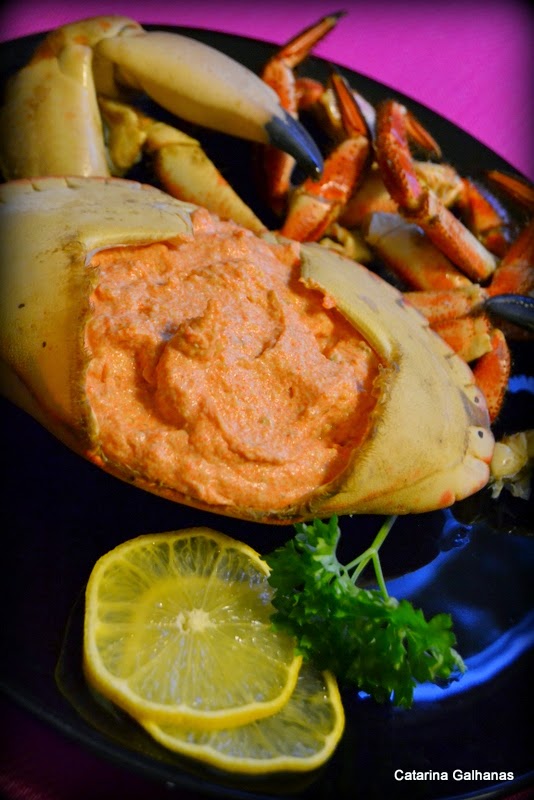
CRAB PATÉ PORTUGUESE STYLE


Pickles have been around for thousands of years, dating as far back as 2030 BC when cucumbers from their native India were pickled in the Tigris Valley. The word “pickle” comes from the Dutch pekel or northern German pókel, meaning “salt” or “brine,” two very important components in the pickling process. Throughout history pickling was a necessity, as it was the best way to preserve food for a long period of time. As one of the earliest mobile foods, pickles filled the stomachs of hungry sailors and travelers, while also providing families with a source of food during the cold winter months.


Serves 4
30 minutes + 1 hour chilling
120 kcal


Ingredients
  • 800 g cooked crab 
  • 1 egg, hard-boiled 
  • 4 tbsp of mayonnaise 
  • 2 tbsp mustard 
  • 20 g pickles

Method
  1. Start by removing the meat from the crab, saving the shell for serving. If you have never done this before there are a lot of great videos on the internet which shows you how to.
  2. In a blender mix the crab meat with the mayonnaise, mustard, pickles and egg until a smooth paté, then season with salt to taste. 
  3. Wash the crab shell and then pat dry.
  4. Fill the shell with the crab paté, then refrigerate for 1 hour. 
  5. Serve the paté with unsalted crackers.

Saturday, June 7, 2014

SPICY SAUSAGES WITH MUSHROOMS & OLIVES


The olive was native to Asia Minor and spread from Iran, Syria and Palestine to the rest of the Mediterranean basin 6,000 years ago. It is among the oldest known cultivated trees in the world - being grown before the written language was invented. The olive tree is one of the heartiest of all trees on the planet: able to survive salt water, adapting itself to almost any sunny and temperate environment, able to thrive in most soils, retaining its leaves year round, and living in some cases more than a thousand years, occasionally bearing fruit for centuries. From biblical times, the olive tree has served as a symbol of sacredness, peace and unity.


Serves 10
15 minutes


Ingredients
  • 2 spicy sausages (80% meat), cut into 1cm thick slices
  • 8 large mushrooms, cut in quarters
  • 1 can small green olives
  • Toothpicks

Method
  1. Fry the sausages and mushrooms in a frying pan for a few minutes.
  2. Let cool, then onto each toothpick, place one piece of sausage, one mushroom and finally one olive.

WATERMELON WITH FETA CHEESE


Watermelon can be both the fruit and the plant of a vine-like plant originally from Africa, and is one of the most common types of melonThe first recorded watermelon crop was found in Egypt, as it was depicted in hieroglyphics on tomb walls dating back as far as 3000. Being held in such high regard, watermelons were left as food to nourish the dead in the afterlife. It was also a valuable and portable source of water for desert situations and when natural water supplies were contaminated. From Egypt, watermelons spread throughout countries along the Mediterranean Sea by way of merchants. They were documented in China in the 10th century, and in the 13th century they were introduced to the rest of Europe by the Moors. It wasn't until 1615, however, that the word "watermelon" first appeared in the English dictionary. 

Watermelons are rich in electrolytes and water content, very low in calories and fats yet very rich source of numerous health promoting phyto-nutrients and anti-oxidants that are essential for optimum health,  a good source of potassium, an excellent source of different vitamins. 


Serves 10
15 minutes


Ingredients
  • 1/4 watermelon
  • 200 g feta cheese
  • Toothpicks

Method
  1. Cut the watermelon and feta cheese into cubes.
  2. Place a piece of feta cheese on each watermelon cube, then stick a toothpick through.

BACON WRAPPED BLUE CHEESE FILLED MUSHROOMS


Blue Vein cheeses also called Blue cheese is a generic term used to describe cheese produced with cow's milk, sheep's milk, or goat's milk and ripened with cultures of the mold Penicillium. The final product is characterized by green, grey, blue or black veins or spots of mold throughout the body. These veins are created during the production stage when cheese is 'spiked' with stainless steel rods to let oxygen circulate and encourage the growth of the mold. This process also softens the texture and develops the distinctive blue flavor. 

The origin of Blue cheese has an interesting story. It is thought to have been invented by accident when a drunken cheese maker left behind a half-eaten loaf of bread in moist cheese caves. When he returned back, he discovered that the mold covering the bread had transformed it into a blue cheese.


Serves 20
30 minutes


Ingredients
  • 20 fresh mushrooms, stems removed
  • 450 g blue cheese
  • 450 g bacon, cut in half
  • 20 toothpicks

Method
  1. Preheat the oven to 175 degrees C.
  2. Stuff the mushroom caps with the blue cheese.
  3. Wrap each mushroom with a half-slice of bacon, and secure with a toothpick.
  4. Place on a baking sheet, then bake for 20 minutes in the preheated oven, until the bacon is cooked through.

SALMON ROLLS WITH SHRIMP


Dill is native to southern Russia, western Africa and the Mediterranean region. It has been used for its culinary and medicinal properties for millennia. Dill was mentioned both in the Bible and in ancient Egyptian writings. Dill's name comes from the old Norse word dilla which means "to lull." This name reflects dill's traditional uses as both a carminative stomach soother and an insomnia reliever. Today, dill is a noted herb in the cuisines of Scandinavia, Central Europe, North Africa and the Russian Federation.


Serves 10
30 minutes


Ingredients
  • 400 g shrimps, peeled and coarsely chopped
  • 1 dl mayonnaise
  • 1 dl dill, finely chopped
  • 2 tbsps freshly grated horseradish
  • 1 tbsp lemon juice
  • 250 g smoked salmon, thinly cut into 2 long rectangular pieces

Method
  1. Mix the prawns with the mayonnaise, dill and horseradish.
  2. Season with lemon juice, salt and pepper.
  3. Place the salmon slices on plastic wrap.
  4. Spread the shrimp mixture on each piece of salmon, starting at the wider end, roll salmon up into cylinders.
  5. Set in the fridge for 1 hour or so to make slicing easier.
  6. Cut into 2 cm thick slices and place on a serving dish.